
Meet the Team
Christian Tetteh
Founder
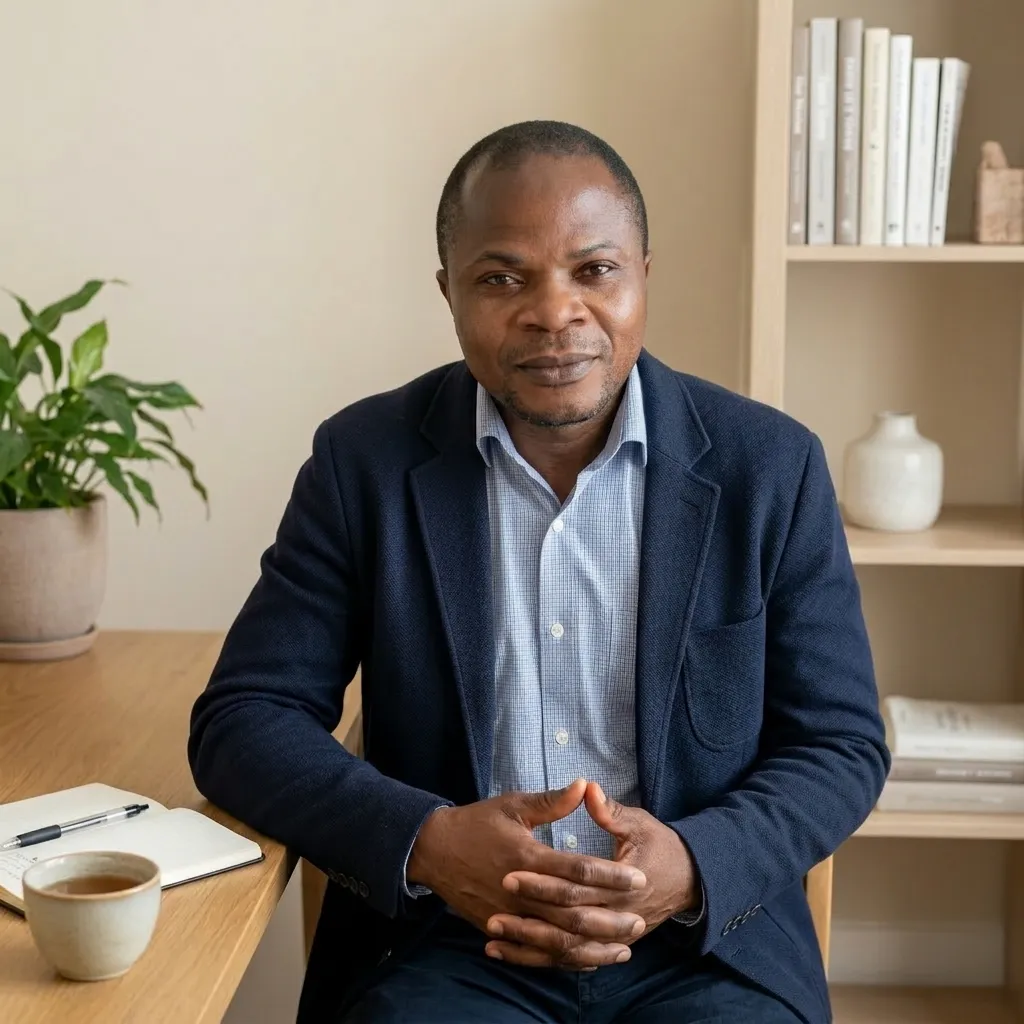
Instability entered my life early—not as an idea, but as a condition. Growing up in the wake of parental divorce and single-parent survival, I learned responsibility before I had language for it. I became unusually attuned to patterns: what people say, what they avoid, how systems hold—or fail—when pressure rises. That early exposure formed a lifelong question that still drives my work: how do human systems organize, fracture, and rebuild—internally and relationally?
As a kid, I gravitated toward structure. Community and ritual gave me rhythm, meaning, and accountability—a stabilizing architecture when life felt unpredictable. Over time, those environments became an early laboratory for observing how identity forms inside belief systems, how practices regulate emotion, and why coherence matters more than performance.
By nineteen, observation turned into leadership. I taught, preached, and led weekly groups of 30 to 45 people. That experience established a principle I’ve never outgrown: authority only works when it’s rooted in inner congruence—not role, charisma, or image. When leadership is performative, systems eventually destabilize. When leadership is aligned, people can actually reorganize.
Later, life tested my own assumptions. I encountered the very outcome I once believed I could prevent through external safeguards alone. It clarified a truth I now consider foundational: external structure cannot compensate for unexamined internal systems. Sustainable stability requires direct engagement with conditioning—nervous system patterns, attachment strategies, belief architecture, and the behaviors that emerge from them under stress.
That realization shaped my professional direction. I pursued formal training in natural science and behavioral science and worked across developmental disability services, forensic environments, psychiatric care, and mental health settings—spaces where theory meets complexity, and regulation is not a concept but a necessity.
Across those domains, I saw the same pattern repeat: breakdown is rarely a willpower problem. More often, it is a systems problem—internal systems shaped in conditions that never supported coherence in the first place. Early disruption, fragmented meaning, chronic dysregulation, and survival-based behaviors do not resolve through insight alone. They resolve through repatterning: clear mechanisms, consistent practice, and structure that supports integration.
This course is built from that intersection: lived experience, scientific grounding, and frontline exposure to high-stakes human systems. My work integrates disciplines often separated—neuroscience and spiritual literacy, meaning and mechanism, sovereignty and support—without collapsing into ideology.
I don’t teach this as a guru. I teach it as a systems-oriented practitioner. Trauma-aware without being trauma-identified. Spiritually grounded without bypass. Execution-focused, because real change is built, not declared.
In this framework:
• Values aren’t abstractions—they’re structural pillars.
• Healing isn’t performative—it’s practiced.
• Sovereignty isn’t claimed—it’s constructed.
This isn’t a brand story.
It’s provenance.
And it underpins everything you’re about to learn.

Outsmarting the Narcissist
Psychological Edition · Hardcover & Paperback
Direct Contact
Want to Reach Christian Directly?
For speaker invites, interview requests, partnership inquiries, or personal and official matters, you can reach Christian directly by email.
Facebook
Instagram
Youtube
TikTok